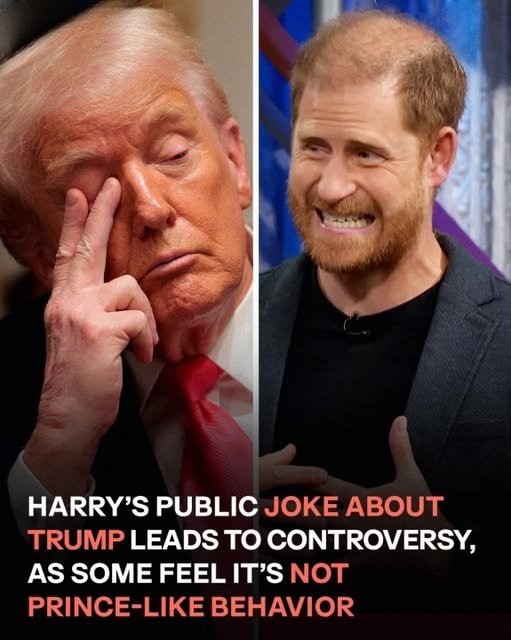
When Prince Harry walked onto the set of The Late Show, he wasn’t just making a surprise cameo; he was entering a distinctly American arena of political commentary. Stephen Colbert, a master of the genre, provided the perfect foil. The segment’s premise—lampooning America’s love for royalty-themed holiday films—was innocuous, but Harry swiftly steered it into more charged territory. His remark about Americans “choosing a king” transformed a cozy chat about movies into a moment of wry political observation, directly linking the fictional royalty on screen to the very real, self-styled “king” imagery propagated by Donald Trump. In doing so, Harry reminded everyone that his life in America is inextricably linked to its political landscape.
The delivery was casual, but the calculation was evident. Harry’s quip served multiple purposes: it got a laugh, it showcased his adaptability to American pop culture, and it offered a subtle rebuttal to the former president’s recent and past remarks about him and his wife. By using humor, he maintained the high ground, avoiding a direct, messy feud while still getting his point across. The studio audience’s audible mix of shock and delight confirmed the joke’s impact; it was a risk that paid off in the moment, generating the exact kind of buzzy, water-cooler moment late-night shows crave.
Online, the risk was met with predictable reward and punishment. Critics, particularly those with a more formal view of royalty, pounced, using the appearance to decry Harry’s continued departure from traditional royal reserve. Their comments painted a picture of a man lost, seeking validation in the wrong venues. Conversely, his supporters saw a man confidently owning his new reality, engaging with American culture on its own terms and standing up for himself with wit rather than wrath. This split-screen reaction is now the defining soundtrack to Harry’s public life, a constant chorus of boos and cheers that follows his every step.
The joke’s significance is magnified by the immediate backdrop. Only recently, Trump had publicly addressed the legal challenges to Harry’s visa, offering a characteristically blunt and personal assessment. Harry’s response, delivered not through a lawyer or a statement but through a punchline on CBS, signaled a new phase of engagement. It demonstrated an understanding that in the modern media ecosystem, especially in the U.S., a well-placed joke on a popular show can be a more effective and controlled form of communication than a traditional press release.
This episode is yet another data point in the intense, 24/7 analysis of the Sussexes. From their charitable work to their children’s public appearances, nothing is simple or free from microscopic—and often absurd—scrutiny. Harry’s foray into late-night political humor, therefore, feels like a conscious tactic. It’s an attempt to steer the conversation, to inject his own voice and personality into the narrative on his terms. He may not be able to stop the world from watching, but on a stage like Colbert’s, he can at least try to make them laugh—or think—on his own cue.